
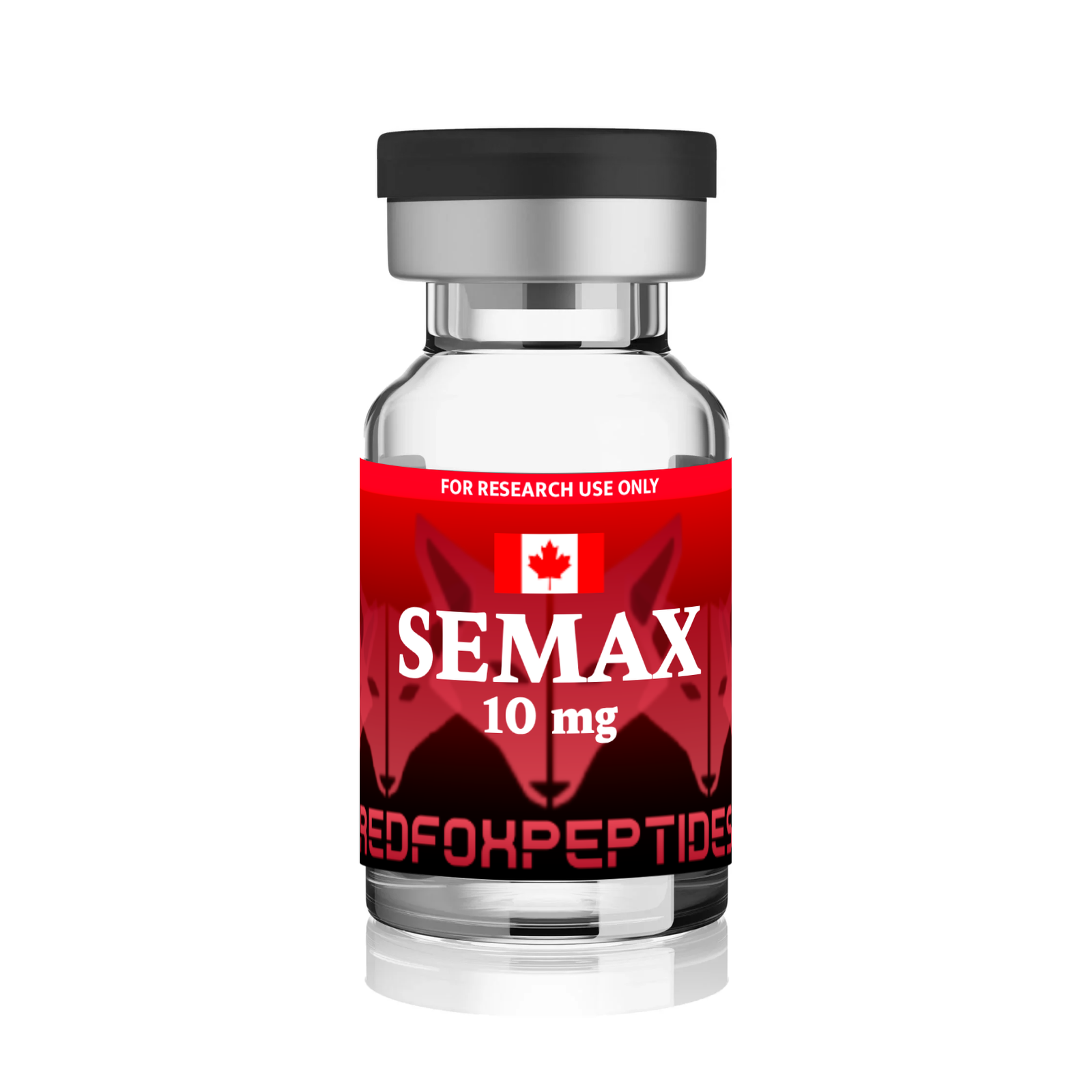
SEMAX – 10 mg
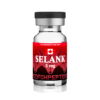
$55.00
Semax is a powerful research peptide derived from a fragment of ACTH, celebrated for its non-stimulant cognitive effects.
By targeting the regulation of BDNF and serotonin systems, it offers a unique pathway for supporting neuroprotection, focus, and memory.
It remains one of the most researched and sought-after peptides for those exploring the frontiers of cognitive optimization.
SEMAX Ships from Canada!
- 2-4 Day Delivery
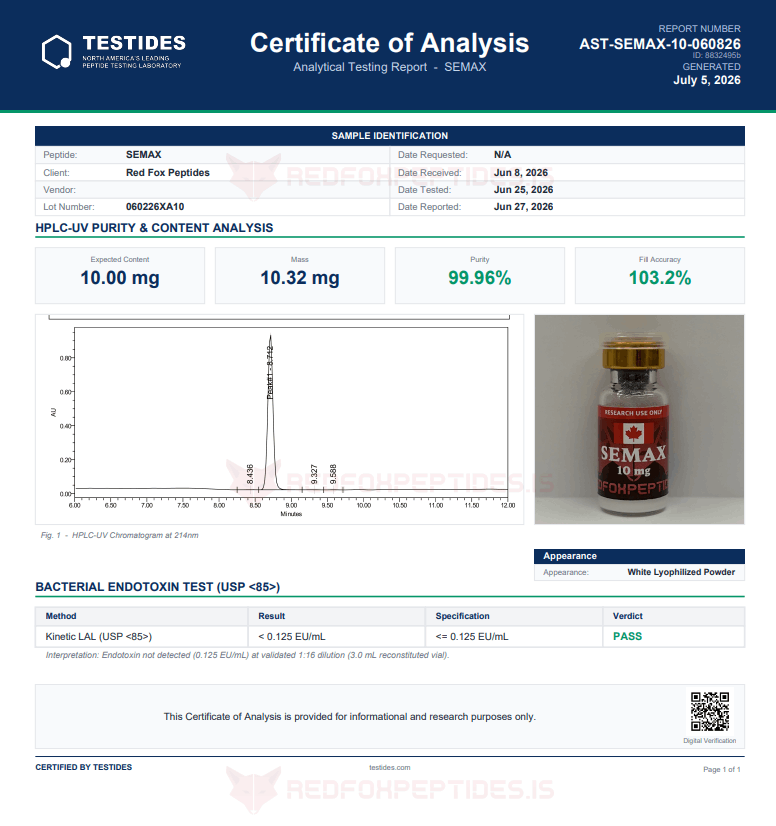
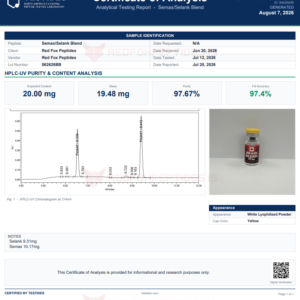
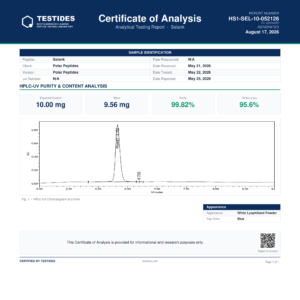
- 3rd Party Tested via Testides
- 99.96% Purity (Verified)
- COA Available
The Science Behind Semax
peptides semax, SEMAX is a fascinating compound with a rich scientific profile. Developed in Russia in the 1980s, it’s a peptide derived from adrenocorticotropic hormone (ACTH), specifically designed to enhance brain function and protect neural tissue.
Mechanism of Action:
- Neuroprotective Effects: SEMAX appears to shield neurons from oxidative stress and apoptosis, key contributors to neurodegenerative diseases like Alzheimer’s and Parkinson’s.
- BDNF Stimulation: It boosts levels of brain-derived neurotrophic factor (BDNF), a protein crucial for neuron survival, growth, and synaptic plasticity.
- Neurotransmitter Modulation: SEMAX interacts with dopaminergic and serotonergic systems, increasing dopamine release and serotonin metabolites like 5-HIAA, which may enhance mood and cognitive function.
- Anti-inflammatory Properties: It reduces the expression of pro-inflammatory genes and modulates immune responses, especially in ischemic conditions like stroke.
Chemical Structure:
- SEMAX is a heptapeptide (seven amino acids): Met-Glu-His-Phe-Pro-Gly-Pro.
- It’s a modified fragment of ACTH, with structural tweaks that enhance stability and biological activity.
Research Applications:
- Stroke Recovery: Shown to improve motor function and accelerate recovery in ischemic stroke patients.
- Cognitive Enhancement: Studied for its potential to improve memory, learning, and stress resilience.
- Immune Modulation: Alters gene expression related to immune and vascular systems, suggesting broader therapeutic potential.
Why Semax?
Cognitive Enhancement:
- Memory & Learning: SEMAX may boost memory formation and retention by increasing brain-derived neurotrophic factor (BDNF), which supports neuroplasticity.
- Focus & Attention: Some users report sharper concentration and reduced mental fatigue, especially during demanding tasks.
- Stress Resilience: It’s believed to help maintain cognitive performance under stress, making it popular among students, professionals, and athletes.
Mental Health & Mood:
- Anxiolytic Effects: SEMAX interacts with dopamine and serotonin pathways, potentially reducing anxiety and improving mood.
- ADHD & Depression: Anecdotally, some users find relief from symptoms of ADHD and mild depression, though clinical evidence is limited.
Neuroprotection & Recovery:
- Stroke & Brain Injury: In Russia, SEMAX is prescribed to aid recovery from strokes and ischemic attacks by protecting neurons and enhancing blood flow.
- Neurodegenerative Conditions: It’s being explored for its potential in slowing progression of diseases like Alzheimer’s and Parkinson’s.
Physical Performance:
- Bodybuilding Use: Some athletes use SEMAX to reduce brain fog post-workout and improve focus during training. There’s even speculation it may help prevent cardiac hypertrophy in enhanced bodybuilders, semax peptide canada
Studies and Refrences: peptides semax
1. Cognitive Enhancement, ADHD & Nootropic Effects
These studies focus on Semax’s ability to improve memory, attention, and learning, as well as its potential application for ADHD.
- Human Operator Efficiency Study This key human study investigated the effects of Semax on operators performing monotonous tasks. It found that Semax improved attention and short-term memory while reducing errors, with effects lasting up to 24 hours.Synthetic ACTH analogue Semax displays nootropic-like activity in humans (PubMed)
- Potential for ADHD & Rett Syndrome This paper proposes Semax as a therapeutic for ADHD and Rett syndrome due to its ability to modulate dopamine and stimulate BDNF synthesis, arguing it may be a safer alternative to psychostimulants.Semax, an analogue of adrenocorticotropin (4-10), is a potential agent for the treatment of attention-deficit hyperactivity disorder and Rett syndrome (PubMed)
- Interaction with Dopamine & Serotonin A rodent study demonstrating that Semax activates the striatal serotonergic system and enhances the release of dopamine when combined with psychostimulants, suggesting a modulation of the reward system.Semax, an ACTH(4-10) analogue with nootropic properties, activates dopaminergic and serotoninergic brain systems in rodents (PubMed)
2. Stroke Recovery & Ischemia (Neuroprotection): peptides semax
This is the primary medical indication for Semax in Russia. The research generally focuses on its ability to protect neurons from oxygen deprivation and restore function after a stroke.
- Gene Expression in Ischemia A genome-wide transcriptional analysis showing that Semax significantly alters the expression of genes related to the immune and vascular systems during a stroke (ischemia), providing a genetic basis for its neuroprotective effects.The peptide semax affects the expression of genes related to the immune and vascular systems in rat brain focal ischemia (PubMed)
- Neurotrophin Activation in Stroke This study demonstrated that Semax activates the transcription of neurotrophins (like NGF and BDNF) and their receptors in the brain after occlusion (stroke), which aids in neuronal survival.Semax and Pro-Gly-Pro Activate the Transcription of Neurotrophins and Their Receptor Genes after Cerebral Ischemia (Springer)
- Restoration of Memory after Ischemia Research indicating that intranasal Semax can help restore memory and learning capabilities that were damaged by chronic brain ischemia.Semax intranasal improve memory deficiency in conditions of experimental chronic brain ischemia (ResearchGate)
3. Mechanism of Action (BDNF & Physiology)
These studies explain how Semax works, primarily focusing on its relationship with BDNF, a protein vital for neuroplasticity.
- BDNF and TrkB Expression This study is often cited in the “biohacking” community. It shows that a single dose of Semax can increase BDNF levels and activate TrkB receptors in the hippocampus, which facilitates neuroplasticity.Semax, an analog of ACTH(4-10) with cognitive effects, regulates BDNF and trkB expression in the rat hippocampus (PubMed)
- Binding Sites in Basal Forebrain Research identifying specific binding sites for Semax in the basal forebrain and confirming that it increases BDNF protein levels in this specific region.Semax, an analogue of adrenocorticotropin (4-10), binds specifically and increases levels of brain-derived neurotrophic factor protein in rat basal forebrain (PubMed)
- Counteracting Developmental Damage A study showing that Semax could reverse behavioral and neurochemical damage caused by early-life exposure to antidepressants (fluvoxamine), normalizing serotonin levels and behavior.Semax, synthetic ACTH(4-10) analogue, attenuates behavioural and neurochemical alterations following early-life fluvoxamine exposure in white rats (PubMed)
4. Optic Nerve Disease: peptides semax
- Therapeutic Effect in Optic Nerve Disease Clinical data evaluating Semax’s effectiveness in treating optic nerve atrophy and inflammatory diseases of the optic nerve, noting improvements in visual acuity and field of view.Evaluation of therapeutic effect of new Russian drug semax in optic nerve disease (PubMed)
Be the first to review “SEMAX – 10 mg”
Related products
Focus & Cognition
Focus & Cognition
Reviews
There are no reviews yet.